facebook-pixel ...

We specialize in the installation and service of top-quality fences and gates, including automation, for commercial premises.

Address

(206) 848-9565

18648 72nd Ave S, Kent, WA 98032

Expert Solutions
Chain Link Fence Installation in Seattle, WA

The Most Reliable Perimeter Fence Built. Done Right, It Lasts Decades.

Chain link has a reputation for being utilitarian. That's fair — it's not a decorative fence. What it is, is the most proven perimeter security solution in commercial and residential fencing, and when it's installed to the right spec for your application, it performs without drama for 20-30 years. At Inline Security Fence, we've built chain link systems for petroleum industry sites, King County public projects, commercial warehouses, and residential yards across the Seattle–Tacoma area. We know what spec the job actually needs — and we build to it.

logo

    Testimonials

    What Our Clients Say

    Real Feedback from Seattle–Tacoma Property Owners

    DSC_6607

    Why Chain Link Still Wins for Security and Value

    Strength, Visibility, and Low Maintenance — Built for the Pacific Northwest

    Chain link fencing gives you something most other fence styles can’t: full perimeter visibility with a barrier that’s genuinely difficult to breach quietly or quickly. For commercial properties, construction sites, schools, and industrial facilities, that combination is exactly what security requires. For residential properties, it’s a dependable solution for yard enclosure, pet containment, and boundary marking at a cost that wood and ornamental iron can’t match.

    In Seattle’s climate, galvanized steel chain link is one of the most weather-resistant fencing materials available. It doesn’t absorb moisture, doesn’t rot, doesn’t warp, and doesn’t need sealing or staining. The maintenance requirement over a 20-year lifespan is close to zero. That makes it particularly well-suited to the constant wet of Pacific Northwest winters, commercial sites that can’t afford downtime for fence maintenance, and property owners who want a fence that simply works.

    What We Build

    Chain Link for Every Application — Spec'd to the Job, Not the Catalog

    With cedar or vinyl fencing, the gap between contractors mostly comes down to installation quality. With ornamental iron, the gap starts much earlier — at fabrication. Here’s what that means in practice.
    DSC_6606
    Residential Chain Link

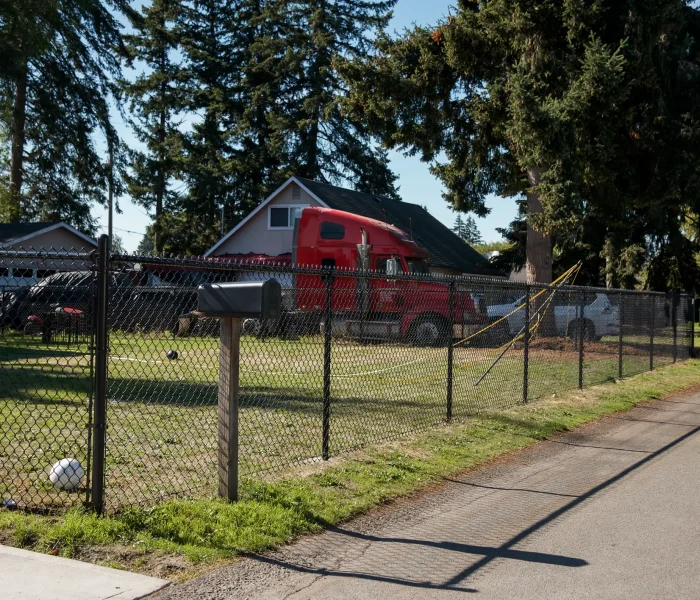
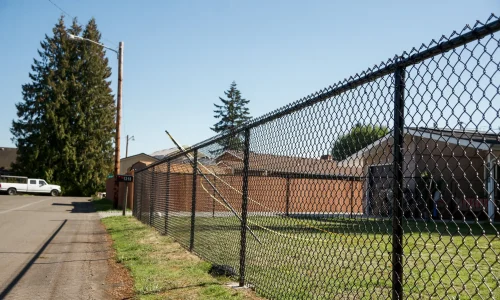
    Yard enclosures, pet containment, property boundary fencing for homes and multi-family properties. Standard residential chain link uses 11.5-gauge galvanized wire on a 2" diamond pattern — sufficient for most applications. Where a dog is involved, we'll talk through mesh size and gauge based on the breed and behavior, not just install the default and hope it holds.
    DSC_6607
    Commercial Chain Link

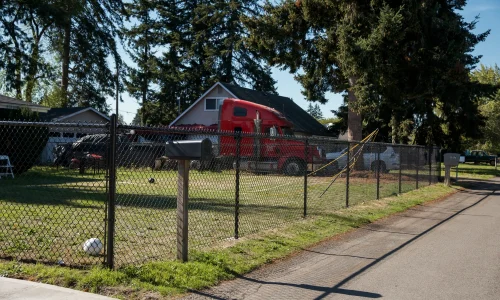
    Perimeter security for commercial lots, warehouses, construction sites, schools, and industrial facilities. Commercial applications typically require heavier gauge wire — 9 or 11 gauge — and may call for barbed wire, razor ribbon, or privacy slats depending on the security requirements of the site. We've built commercial chain link systems for petroleum industry operations, King County public sites, and large-scale construction projects across the region.

    Security Enhancements

    Chain link is highly customizable depending on what the fence needs to do:

    Residential Chain Link

    Privacy Slats: Woven into the mesh to block sightlines while maintaining fence integrity. Available in multiple colors and commonly used on commercial lots, schools, and properties where visual screening is as important as security.

    Barbed Wire & Razor Ribbon

    Designed for high-security commercial and industrial applications. Installed on angled arms at the top of the fence to provide an added layer of perimeter protection.

    Vinyl Coating

    Available in black, green, or brown. Offers better corrosion resistance than galvanized chain link in coastal and urban environments while providing a cleaner, more attractive appearance for commercial properties.

    Heavier Gauge Wire & Tighter Mesh

    Standard residential chain link is relatively easy to climb. Heavier-gauge wire, smaller diamond mesh, and reinforced top rails with tension wire create a significantly stronger and more secure fence. We'll recommend the right configuration based on your property's security needs.

    The Spec Matters More Than Most Clients Realize

    Why Two Chain Link Fences That Look Identical Can Perform Very Differently

    Chain link looks straightforward. The variation between a fence that holds up for 30 years and one that corrodes and sags in five comes down to three things most clients don’t think to ask about.

    DSC_6607
    Wire gauge

    Standard residential chain link is 11.5-gauge. A heavier 9-gauge wire is stiffer, harder to cut, and holds tension better over time. The difference isn't visible once the fence is up — but it's significant in how the fence performs and how long it lasts.

    DSC_6606
    Galvanization quality

    Not all galvanized steel is the same. Hot-dipped galvanized coating is significantly thicker and more durable than electro-galvanized, especially in Seattle's wet climate where the fence is constantly exposed to moisture. A fence built to the right galvanization spec will outlast a cheaper alternative by a decade or more.

    DSC_6607
    Post depth and concrete

    Posts set too shallow will lean. In Seattle's freeze-thaw cycles and saturated soils, an under-set post doesn't need a dramatic event to shift — it just gradually moves, pulling the fabric with it. We set every post to depth in concrete, every time.

    These aren’t upsells. They’re the difference between a fence that performs and one that needs to be replaced.

    Our gallery

    Finished Projects

    Chain Link Fences We've Built Across Seattle–Tacoma

    Every project below was built by our in-house crew — no subcontractors, same standard on every job from residential yards to large commercial sites.

    Our Process

    What Actually Happens When You Call Us

    No Runaround. No Surprise Costs.

    On Site Consultation

    Step 1:

    On-Site Consultation

    We look at the site, talk through what the fence needs to accomplish, and spec the right gauge, mesh size, coating, post depth, and security enhancements for your specific application. Not the default — the right call.

    A Real Quote

    Step 2:

    Straight Written Quote

    You get a line-item estimate with no hidden costs. If something about your site creates a variable — unusual soil conditions, a significant grade change, utility conflicts — we flag it before we start.

    Installation by Our Crew

    Step 3:

    Installation by Our Crew

    Our in-house team handles the full installation, from post setting to fabric tension to gate hardware. No subcontractors, no handoffs.

    Final Walkthrough

    Step 4:

    Final Walkthrough and Warranty

    We walk the fence with you, operate every gate, and don’t consider the job done until you’re satisfied. Backed by our 3-year craftsmanship warranty.

    DSC 6607
    DSC 6606
    FAQ

    Frequently Asked Questions

    What gauge wire should I use for my chain link fence?

    It depends on the application. For standard residential yard enclosure and pet containment, 11.5-gauge is appropriate. For commercial sites, security-sensitive applications, or anywhere a heavier barrier is needed, 9 or 11 gauge is the right call. If dogs are involved, tell us the breed and size — mesh pattern and gauge both factor into containment. We'll recommend the right spec rather than defaulting to whatever's cheapest.

    What's the difference between galvanized and vinyl-coated chain link?

    Galvanized chain link has a zinc coating applied to the steel wire that resists corrosion. Vinyl-coated chain link adds a PVC layer over the galvanized wire, which provides additional corrosion resistance and color options — black, green, or brown. Vinyl-coated performs better in coastal and urban environments where salt air and pollution accelerate corrosion, and it presents better aesthetically. It costs more than standard galvanized; whether that trade-off makes sense depends on your site and your priorities.

    Can chain link be installed on a sloped property?

    Yes. We install chain link on sloped lots regularly using racked or stepped installations. Racking follows the slope continuously for a cleaner line; stepped installations drop in increments that better suit steeper grades. We'll assess your site and recommend the right approach.

    Do I need a permit for a chain link fence in Seattle or King County?

    In most residential zones, fences under 6 feet don't require a permit. Commercial chain link, fences over 6 feet, or installations near setback areas may require permits — and the rules vary by municipality across Kent, Bellevue, Renton, Kirkland, and Seattle. We know the local codes and will flag anything that needs a permit before we break ground.

    How long does chain link fence installation take?

    Most residential installations are completed in 1-2 days. Commercial or large-scale perimeter projects take longer depending on total footage, terrain, and gate complexity. You'll get a firm timeline in your written quote.

    Can you add privacy slats or security enhancements to an existing chain link fence?

    Yes, in most cases. Privacy slats, barbed wire, and vinyl coating can be added to existing chain link systems depending on the condition of the posts and fabric. We'll assess what's there before recommending what can be added cleanly.

    What maintenance does chain link require?

    Very little — which is one of the main reasons it's specified for commercial and industrial sites. Inspect annually for any bent sections or loosened hardware. If the fabric is galvanized or vinyl-coated and was properly installed, it will hold up in Seattle's climate for decades without significant intervention.

    Is chain link a good option for dog containment?

    Yes, with the right spec. Standard 2" diamond mesh is sufficient for most dogs. For breeds that are determined climbers, a top rail with inward-angled coyote rollers or a higher fence height is more effective than just a heavier gauge. For diggers, a buried mesh apron along the base is worth adding at installation. Tell us about your dog and we'll build the containment that actually works.

    Start with a quick form

    Call Us. We'll Pick Up.

    Whether you're securing a commercial site or enclosing a residential yard, one conversation gets you a straight answer on spec, cost, and timeline. We come to the site, assess what the job actually needs, and give you a written quote with no surprises.

    Address:

    18648 72nd Ave S, Kent, WA 98032

      By providing your number, you consent to receive text messages from Inline Security Fence related to marketing and promoting offers. To unsubscribe, simply reply "STOP."