facebook-pixel ...

We specialize in the installation and service of top-quality fences and gates, including automation, for commercial premises.

Address

(206) 848-9565

18648 72nd Ave S, Kent, WA 98032

Expert Solutions
Ornamental Iron Fence Installation in Seattle, WA

We Don't Install Catalog Panels. We Build Your Fence From Steel.

Most companies selling "ornamental iron" are installing pre-fabricated panels from a distributor — the same designs showing up on properties across the entire region. At Inline Security Fence, we weld and fabricate in-house. That means your fence is designed and built for your property, your gate opening, your grade, your specs. Not adapted from a catalog. Built from steel.

logo

    Testimonials

    What Our Clients Say

    Real Feedback from Seattle–Tacoma Property Owners

    4 (1)

    What Ornamental Iron Actually Requires to Be Done Right

    Presence. Security. A Finish That Holds in Seattle's Climate.

    Ornamental iron is the most permanent fencing decision a property owner makes. When it’s done right — properly welded, primed, and powder-coated — it outlasts every other fence style on the market by decades and adds genuine long-term value to the property. When it’s done wrong, you’re looking at rust running down the panels, welds that crack at the joints, and a gate that sags off its hinge within a few years.

    The difference is almost never the iron. It’s the fabrication and the finish.

    We’ve been building ornamental iron fences and gates in the Seattle area since 2016 — for residential properties in Bellevue and Mercer Island, for commercial sites in Kent and Renton, and for high-security applications like Fort Lawton and the McKinney Center. Every piece of ironwork we produce is fabricated in our own shop, finished with a proper powder-coat process, and installed by the same crew that built it.

    That’s not how most fence companies operate. It’s how we do.

    The Real Difference Between Custom Fabrication and Catalog Panels

    Why In-House Welding Changes Everything for Ornamental Iron

    With cedar or vinyl fencing, the gap between contractors mostly comes down to installation quality. With ornamental iron, the gap starts much earlier — at fabrication. Here’s what that means in practice.
    4 (1)
    True Custom vs. "Semi-Custom"

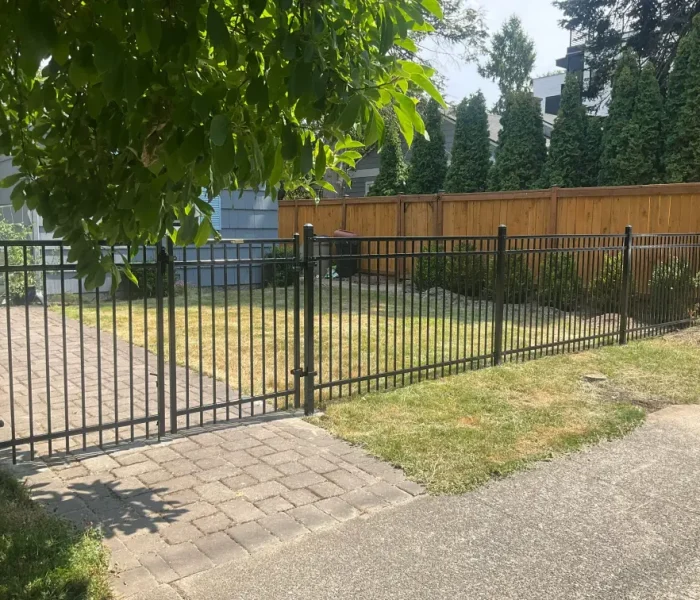
    Most fence companies offering ornamental iron are working with a limited catalog of pre-made panel sizes and designs. They measure your property and order the closest match. If your gate opening is 13'4" wide, you get a panel cut down from a 14' section or padded out with filler. If your lot slopes, the panels get shimmed. It works — but it's visible, and it's not what you paid for. When we fabricate in-house, your gate is built to 13'4". Your panel height accounts for the exact grade change at each post. The design elements — whether you want flat-top rails, spear finials, decorative scrollwork, or a clean industrial bar pattern — are fabricated to spec, not approximated from stock.

    234615ce-9970-4202-a736-dc0f7a8414c2_cdv_photo_001-7gyxu3va0qj (1)
    Weld Quality Is the Structural Foundation

    Every joint in an iron fence is only as strong as the weld holding it. Poorly executed welds — inconsistent penetration, inadequate prep, insufficient filler material — look fine until the fence goes through a few seasons of thermal expansion and contraction in the Pacific Northwest. Then they crack. Our fabricators weld to structural standards, not cosmetic ones. The joints are ground smooth, inspected, and primed before anything goes to powder coat.

    4 (1)
    The Powder-Coat Process Determines How Long It Lasts

    Powder coating is what stands between your iron fence and Seattle's climate. A proper powder-coat finish requires thorough surface prep — sandblasting or chemical stripping to bare metal, a zinc-phosphate primer coat to prevent corrosion from spreading under the finish, and then the powder-coat layer applied electrostatically and baked to cure. Skip any of those steps and you're looking at finish failure within three to five years in our wet climate. We don't skip steps, because we're backing the fence with a three-year warranty and our own name.

    What We Build

    Ornamental Iron for Residential and Commercial Properties

    Ornamental iron isn’t a single product — it’s a category that covers everything from a simple front yard fence to a fully automated vehicle gate with security integration. We build across the full range.

    234615ce-9970-4202-a736-dc0f7a8414c2_cdv_photo_001-7gyxu3va0qj (1)
    Residential Iron
    Fencing

    Front yard perimeter fencing, garden borders, pool enclosures, driveway gates — built to match your home's architecture and your neighborhood's character. Clean and modern or traditional with decorative elements. We'll show you options based on what you're going for, not just what's in stock.

    234615ce-9970-4202-a736-dc0f7a8414c2_cdv_photo_001-7gyxu3va0qj (1)
    Commercial Iron Fencing and Gates

    Perimeter security, controlled access, site enclosures for commercial and light industrial properties. We've built commercial iron systems for businesses and public sites across King County and beyond. If the application requires security hardware, automated openers, or coordination with access control systems, we've done it.

    4 (1)
    Custom Automated Gates

    A gate that doesn't open reliably is worse than no gate. We build and install swing gates, slide gates, and bi-fold gates with automated operators, and we size the structure to handle the operator — not the other way around. The mechanical load of an automated gate system requires specific post sizing and anchor depth. We engineer it correctly from the start so it operates the same way in year five as it does on day one.

    4 (1)
    Combination Fence Systems

    Ornamental iron pairs well with cedar, concrete, and masonry. If your project involves combining materials — iron panels between brick columns, cedar privacy sections transitioning to open iron, or iron gates integrated into a wood fence line — we design and build the full system in-house.

    Our gallery

    Finished Projects

    Custom Iron We've Built Across the Seattle Area

    Every piece of ironwork below was designed and fabricated by our in-house crew — no pre-made panels, no subcontractors.

    Our Process

    From Design to Installation: One Team, Start to Finish

    On Site Consultation

    Step 1:

    On-Site Consultation and Design

    We come to your property, take accurate measurements, assess the grade, and talk through what you’re building and what you want it to accomplish — security, curb appeal, access control, or a combination. We’ll show you design options and be direct about what fits your property and what doesn’t.

    A Real Quote

    Step 2:

    In-House Fabrication

    Your fence and gate components are fabricated in our Kent shop. Every section is built to your exact dimensions, welded to structural standard, ground and inspected, and prepped for powder coat. You’re not waiting on a distributor’s lead time — we control the production.

    Final Walkthrough

    Step 3:

    Powder Coat Finish

     Panels and components go through our full powder-coat process: surface prep to bare metal, primer, and baked powder-coat finish. Color selection is part of the design conversation. Matte black is the most common choice in Seattle, but we’ll match whatever you need.

    Installation by Our Crew

    Step 4:

    Installation by Our Crew

    The same team that fabricated your fence installs it. Posts are set in concrete to depth. Gate hardware is aligned and tested. Automated operators are wired, programmed, and walked through with you before we leave.

    Final Walkthrough

    Step 5:

    Final Walkthrough and Warranty

    We walk every foot of the fence and operate every gate with you before we consider the job complete. The finished installation carries our 3-year craftsmanship warranty. If anything doesn’t perform, we come back — no runaround.

    234615ce 9970 4202 a736 dc0f7a8414c2 cdv photo 001 7gyxu3va0qj 1
    4 1
    FAQ

    Frequently Asked Questions

    What's the difference between ornamental iron and wrought iron?

    True wrought iron — the material used in historical fencing — hasn't been commercially manufactured at scale since the mid-20th century. What's sold today as "wrought iron" fencing is almost always mild steel, fabricated to look like traditional wrought iron. That's not a drawback — modern mild steel is strong, weldable, and with proper finishing, extremely durable. At Inline, we're straightforward about this: we work with structural steel, we fabricate it in-house, and we finish it to last. Companies still using the term "wrought iron" as a selling point are mostly using it as a style descriptor, not a material specification.

    What finish do you use, and how does it hold up in Seattle's climate?

    We powder-coat all ornamental iron with a process that starts at bare metal — sandblasted or chemically stripped — followed by a zinc-phosphate primer to stop corrosion from traveling under the finish, then electrostatic powder coat baked to cure. In Seattle's climate, surface prep is everything. A powder-coat finish applied over mill scale or flash rust will fail within a few years regardless of how thick the topcoat is. Done properly, a powder-coated mild steel fence holds its finish for 15-20 years or more with minimal maintenance. We back that with our warranty.

    Do I need a permit for an ornamental iron fence in Seattle or King County?

    For most residential ornamental iron fences under 6 feet, no permit is required in Seattle. Fences over 6 feet, fences in certain setback zones, and automated vehicle gates often do require permits — and the requirements vary across municipalities. Kent, Bellevue, Renton, Kirkland, and Seattle each have their own codes. Automated gates that connect to a public roadway may also require a right-of-way permit from the city. We know the local requirements and will flag anything that needs a permit before we break ground. Surprises mid-install are avoidable, and we avoid them.

    Can ornamental iron be installed on a sloped property?

    Yes, and it's one of the areas where in-house fabrication matters most. With catalog panels, slope is handled by raking or stepping — cutting down sections or shimming gaps. With custom fabrication, we build each panel to fit the grade exactly. The result is cleaner lines, tighter tolerances, and a fence that looks intentional rather than adapted. We build on sloped lots regularly across the Eastside and South King County.

    What are the most popular ornamental iron designs in the Seattle area?

    Flat-top rails with simple bar patterns are the dominant choice for modern Seattle homes — clean lines that complement contemporary architecture without competing with it. Spear finials are common on traditional and craftsman-style homes where the iron is meant to read as a security feature as well as a design element. Decorative scrollwork is requested less often for full fence runs but remains popular for accent sections, driveway gates, and entry features. We don't push any particular style — we build what fits the property.

    How much does ornamental iron fencing cost in Seattle?

    Ornamental iron is priced by linear foot and varies significantly based on fence height, design complexity, post size and spacing, and gate requirements. A simple flat-top residential fence at standard height runs less than an elaborate design with decorative elements and custom gate work. Automated gate operators add cost depending on the gate type, weight, and the operator specified. We'll give you a line-item written quote that breaks all of it down — no mystery pricing, no estimates that shift when the crew shows up.

    How long does installation take?

    Most residential ornamental iron fence installations are completed in 2-5 days, depending on total length, grade complexity, and gate specifications. Custom fabrication happens before the install crew arrives, so the on-site timeline is driven by post setting, panel installation, and gate hardware. Automated gate installations add a day for wiring and programming. You'll get a firm start date and completion estimate in your written quote.

    Can you integrate an automated gate with an existing access control or security system?

    Yes. We've coordinated gate automation with keypads, intercoms, card readers, phone-based access systems, and existing security infrastructure on commercial and residential projects. The gate structure and operator are sized to work with the access control hardware — not the other way around. If you already have a system in place, tell us the make and model and we'll spec the installation to be compatible.

    What maintenance does an ornamental iron fence require?

    Less than most people expect if it was finished correctly. An annual inspection for chips or scratches in the powder-coat finish — touch those up with a matching paint to prevent rust from starting at the breach — and a check of gate hardware for alignment and lubrication. Beyond that, an occasional wash to remove environmental buildup. If the fence was properly prepped and powder-coated at installation, the finish will hold for well over a decade without major intervention. We'll walk you through a specific maintenance checklist at your final walkthrough.

    Construction Advices

    The Fabrication Advantage

    Why the Shop Behind the Fence Changes the Quality of What You Get

    Ornamental iron is the one fence category where the conversation has to start with fabrication, not installation. A cedar fence installed by a subcontractor is still cedar. An iron fence fabricated by a production shop from stock panels is still iron. But the fit, the weld quality, the finish process, and the long-term performance of those two approaches are not the same.

    At Inline Security Fence, we have our own fabrication shop in Kent. The people who weld your gate are on our payroll. They work to the same standard on every job because they know the three-year warranty on their work comes back to them. They don’t rush the weld prep because they’re billing by the hour for a company they’ll never see again.

    This is what in-house fabrication actually means for you: a fence that fits your property rather than being adapted to it, welds that hold through a decade of Pacific Northwest weather cycles, and a crew that’s accountable for the full result — design, fabrication, installation, and warranty — under one roof.

    When something is wrong, there’s one phone call. It goes to the same team that built the fence. And we pick up.

    Inline Security Fence Team - Commercial & Residential Fence Experts In Seattle
    Building Fence
    0
    Interiors Design
    0
    Start with a quick form

    Call Us. We'll Pick Up.

    If you're pricing ornamental iron fencing or gates in the Seattle area, one conversation with our team will tell you what you're actually getting compared to what anyone else is quoting. We come to your site, take accurate measurements, and give you a straight written estimate — materials, fabrication, installation, and timeline — before you commit to anything.

    Address:

    18648 72nd Ave S, Kent, WA 98032

      By providing your number, you consent to receive text messages from Inline Security Fence related to marketing and promoting offers. To unsubscribe, simply reply "STOP."