Key Takeaway
Rod iron vs. wrought iron is not a real debate: ‘rod iron’ is almost always a misspelling or mishearing of ‘wrought iron,’ the correct term for iron heated and hammered into shape. True wrought iron contains less than 0.3% carbon and roughly 1-2% slag, but genuine production ended in the 1970s. Nearly every new fence sold today as ‘wrought iron’ is ornamental steel built to mimic that classic look.
Rod Iron vs. Wrought Iron: The Name, the History, the Fence, the Straight Answer
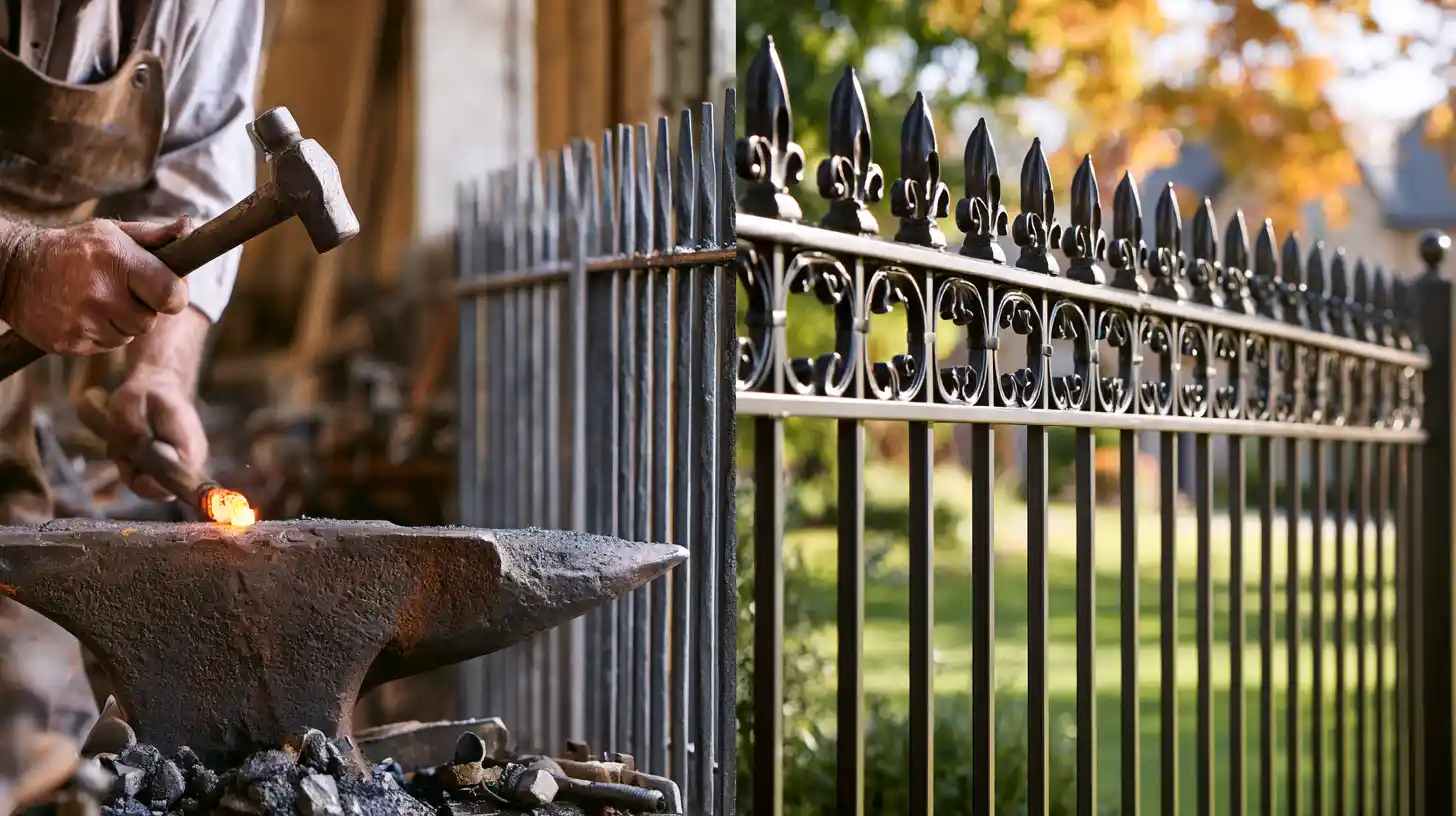
“Rod iron” is almost always a misheard or misspelled version of “wrought iron.” The correct term is wrought iron, which refers to iron that has been worked into shape by heating and hammering. There is a rare, technical sense in which “rod iron” means iron rolled or drawn into thin, round bars or rods, so you sometimes see “straight rods” of stock described that way in a metalworking shop, but that specialized usage rarely comes up in a fencing conversation. Washington State University’s Common Errors in English Usage makes the same point: most people who type “rod iron” mean “wrought iron.”
Here’s the part that actually matters when you’re buying or repairing a fence. In fencing, “wrought iron” is the historic name for hand-worked iron, but almost every new fence with that classic look is really Ornamental Iron or ornamental steel built to resemble the traditional style. Merriam-Webster defines “wrought” as worked into shape by artistry or effort, which tells you the word describes a process, not a modern product line.
If you’re a property owner or facility manager preparing to specify or repair an iron-style fence, or a homeowner who simply wants the look, this is where the terminology stops being trivia and starts affecting your quote. Over the next sections you’ll get the correct term, the real material story behind it, and a short list of questions to ask before you commit to anything. No hype, just the facts a good installer would give you straight, so you end up with the right iron for the job rather than a mismatch you regret.
Why It Is Called Wrought Iron: The Name and the History
“Wrought” is the old past participle of “work.” So wrought iron literally means worked iron: iron that a smith shaped by hand through heating and hammering, again and again, until it took the form they wanted. Merriam-Webster defines “wrought” as worked into shape by artistry or effort, and lists 1678 as the first known use of “wrought iron” in that defined sense.
The phrase is fairly young. The material is not. People were working iron as early as 2000 BC, long before anyone wrote the words down. What made wrought iron special was how it behaved under the hammer. A smith could bend it into curves and scrolls and hold it there without the metal cracking. That property, combined with patient hand labor, is why so much surviving ironwork looks the way it does, and why the hand-forging left visible hammer marks on many old pieces.
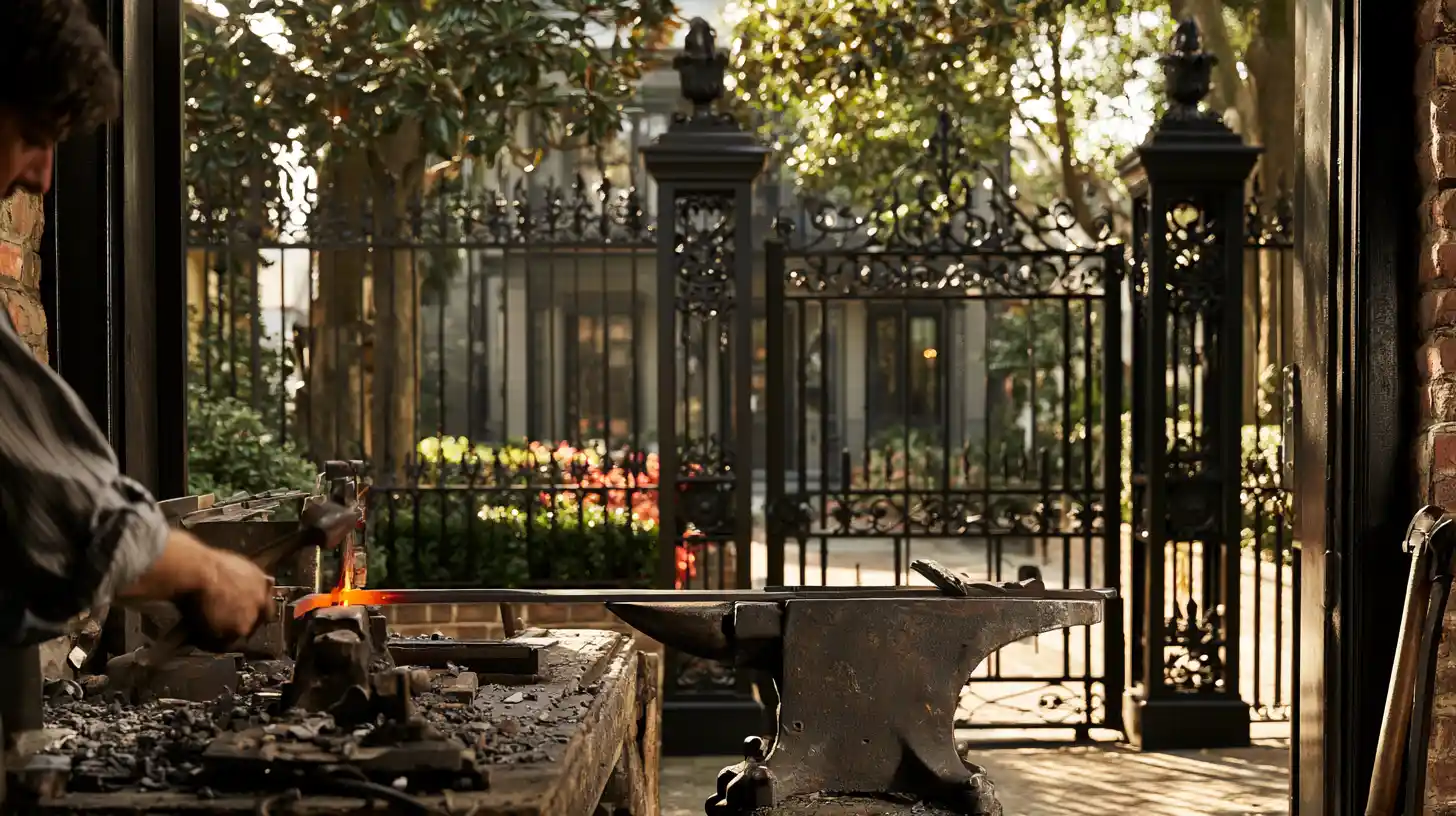
Shaping it was slow work. A smith heated the iron in a forge, moved it to the anvil, hammered it, and repeated the cycle until the piece was done. There were no shortcuts and no machines doing the forming. Every bar, gate hinge, and decorative scroll passed through a person’s hands and simple tools. The whole method was labor intensive by design, and the price of a finished gate reflected the hours a craftsman put into it. Because the metal was easily shaped under heat, straight iron rods of stock became scrolls, finials, and rails one heat at a time. The flat bars a smith started with turned into finished work through nothing but skill and repetition.
That labor is why wrought iron became tied to gates, railings, and fences in the first place. When a metal both resists breaking and takes a shape well, it’s a natural fit for work that needs to be strong and good-looking at the same time. Estate gates, garden railings, and property fences all leaned on it, and so did many purely decorative projects where the ironwork was meant to be admired as much as used. The aesthetic appeal was part of the point, and the craftsmanship was real, and it showed. We’ll come back to why that hand-forged reality is different from what most fence buyers actually receive today.
What True Wrought Iron Actually Is: Materials Science Basics
True wrought iron is a low carbon form of iron. Merriam-Webster defines it as a tough, malleable, relatively soft iron that contains less than 0.3% carbon, usually under 0.1%, and carries 1% or 2% slag mechanically mixed into it. That last detail is the one most people miss, and it’s the reason wrought iron behaves the way it does. The low carbon content keeps the metal soft enough to shape, while the added slag gives it character no modern bar stock has. In materials science terms, the very low carbon content and mixed-in slag are what set this iron alloy apart from later products.
The slag doesn’t dissolve into the metal. It stays mixed in as fine threads running through the iron, sometimes cited at roughly 250,000 slag inclusions per square inch. That gives wrought iron a distinctive fibrous structure, almost like the grain in a piece of wood. When a smith heats and works the iron, those fibers align, and the result is a metal that is highly malleable and ductile. It bends into elaborate designs without snapping, which is exactly why it suited custom designs that a stiffer material could not hold. It is not the same as pure iron or pure elemental iron, since the slag is deliberately part of the mix.
The American Institute of Steel Construction (AISC) puts numbers to this in its steel metallurgy material. Wrought iron differs from low carbon steel or mild steel in bulk chemistry, method of manufacture, microstructure, and its large slag volume. AISC also notes wrought iron is prone to delamination, splitting along those fibers, precisely because of that layered structure. One typical historical example it gives runs around 0.25% carbon or less, with small amounts of manganese, sulfur, phosphorus, silicon, and other elements. Treat those as historical structural values, not a spec sheet for a fence you’d order today.
A few practical points follow from all this. The fibrous texture is a product of how the iron was made and worked, and that fibrous appearance is one of the clearest tells a conservator looks for. Melt it down and cast it into a mold, and you destroy that texture entirely, which is one of the clearest lines between wrought iron and cast iron. Wrought iron is rust resistant to a degree and resists rust somewhat better than plain iron rods, thanks in part to the slag, but it still corrodes over time and still needs maintenance to stay sound. It was never maintenance-free, and neither is any iron-style fence you’ll buy now. Sourcing genuine quality wrought iron today usually means finding salvaged stock, since nobody rolls new iron rods with that composition anymore.
Wrought Iron vs. Cast Iron vs. Cast Steel vs. Carbon Steel: How the Metals Differ
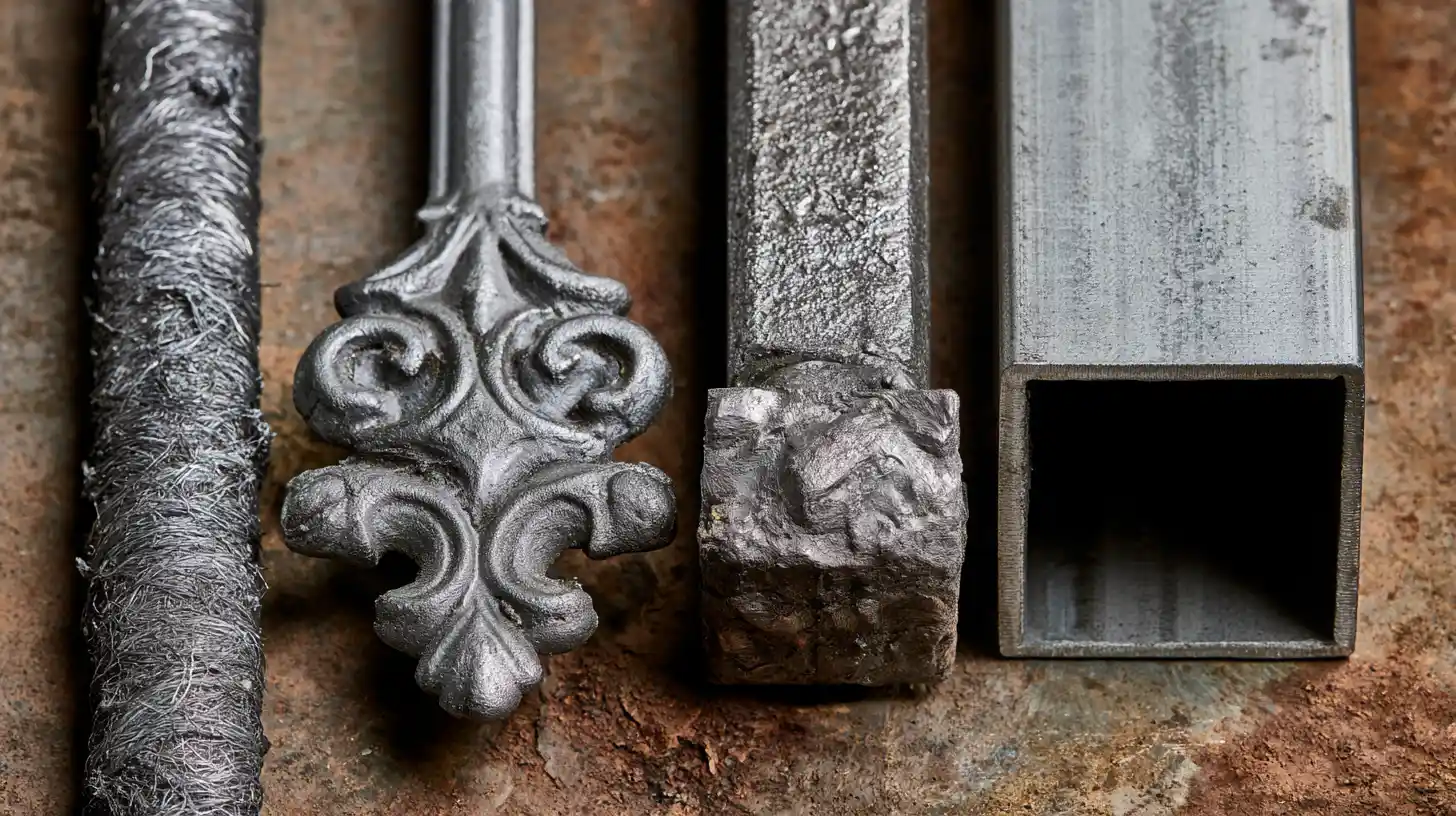
To keep the terms straight, start with one distinction: iron is a chemical element. Steel is a family of alloys built on iron and carbon. Cast iron, wrought iron, and steel differ by chemistry, how they’re made, and their internal structure. The World Steel Association defines steel as an alloy of iron and carbon with less than 2% carbon and 1% manganese, plus small amounts of silicon, phosphorus, sulphur, and oxygen.
A common mistake worth correcting calmly: some sources describe wrought iron as high in carbon. It’s the opposite. Wrought iron is low carbon and slag-bearing. Cast iron is the high-carbon one, which is why it pours easily into molds but tends to be brittle. Cast steel sits between the two in behavior: it is poured into molds like cast iron, but its lower carbon content makes it far tougher and less prone to cracking under load. There is also malleable iron, a heat-treated cast product that trades some brittleness for ductility. Most fence pickets you will see, though, are formed from carbon steel tubing rather than any cast product. Here’s the short version, laid out cleanly.
| Property | True Wrought Iron | Cast Iron | Carbon (Mild) Steel |
|---|---|---|---|
| Carbon content | Low, under 0.3% (usually under 0.1%) | High, typically above 2% | Under 2% carbon, under 1% manganese |
| Structure | Fibrous, with 1-2% slag mixed in | Brittle crystalline structure | Uniform alloy, no fibrous grain |
| How it’s made | Refined and worked by hand, heated and hammered | Melted and poured into molds | Mass-produced (Bessemer process and later methods) |
| Strength / behavior | Malleable, ductile, bends without breaking | Hard but brittle, cracks under impact | Strong, consistent, formable and weldable |
| Typical fence use | Historic gates and railings; restoration today | Decorative posts and ornamental castings | Most modern “wrought iron style” fences |
| Rust behavior | Corrodes, slower than plain iron, needs upkeep | Rusts, needs protective coatings | Rusts with water and oxygen; protected by coatings |
The reason steel dominates today comes down to steel production at scale. The Bessemer process made mild steel cheap to produce steel in large quantities, and mild steel became the practical replacement for hand-worked wrought iron. That’s why so many fences marketed as “wrought iron” are actually carbon steel. A cast iron fence or cast iron post still shows up in decorative work, finials, and ornamental castings, where its ability to hold fine mold detail is an asset and where the metal doesn’t take heavy impact. Cast steel appears in some heavy-duty gate hardware for the same reason wrought iron once did: it takes stress without shattering and holds solid tensile strength under load. The World Steel Association also notes plainly that steel rusts when it meets water and oxygen, which is why coatings, galvanizing and powder-coating among them, matter so much for any steel fence expected to last outdoors. The modern steel industry owes much of its scale to those early advances.
A Short History of Wrought Iron Fences: From Smelting Iron Ore to the Puddling Process
Early wrought iron was refined from pig iron, itself made by smelting iron ore. That iron ore smelting happened in a blast furnace, where iron oxide in the ore reacted with carbon monoxide at high temperature to release the iron. The National Park Service describes how forge workers converted brittle, high-carbon cast iron into malleable wrought iron by carefully removing excess carbon through fining and hammering. It was slow, physical work, and it limited how much wrought iron anyone could make. Every batch started with raw iron ore as the raw material and ended with a metal soft enough to forge, and the fining step was where most of the carbon left the iron.
That changed in 1784, when Henry Cort introduced the puddling process. Puddling oxidized carbon out of molten iron, converting it into wrought iron on an industrial scale rather than one hand-forged piece at a time. A puddler stirred the molten charge in a reverberatory furnace, and as the carbon burned off the metal stiffened into pasty balls that could be hammered and rolled. Unlike pouring molten iron straight into a mold, puddling worked the metal in a near solid state as it thickened. With more material available, wrought iron spread into everyday architecture. The Victorian era is where iron gates and iron fences really took hold, with ornamental fencing, gates, and railings appearing across cities and estates. The look most people picture when they say “wrought iron fence” comes largely from this period, when high demand for decorative ironwork met the new supply.
Then it faded, and for a straightforward reason. Mild steel, mass-produced and cheaper, could do most of the same jobs. Instead of melting pig iron and puddling it by hand, mills poured liquid steel and rolled it by the ton. Industry moved on. Genuine wrought iron production ended in the United States in 1969, and Britain’s last wrought ironworks closed in 1974. Historic England notes there has been no industrial production of historic wrought iron since the 1970s. By the late 20th century, commercial production had ceased worldwide, and steel had become the common form of iron used in construction.
The practical consequence: real wrought iron is now a finite restoration material. When a conservator repairs a historic gate, the wrought iron they source often comes from salvaged stock, not a new mill. For a new fence, that history is interesting context, but it isn’t what will show up on your truck. Understanding this is the difference between asking for a style and specifying a material.
The Modern Fence Reality: “Wrought Iron” Usually Means Ornamental Iron
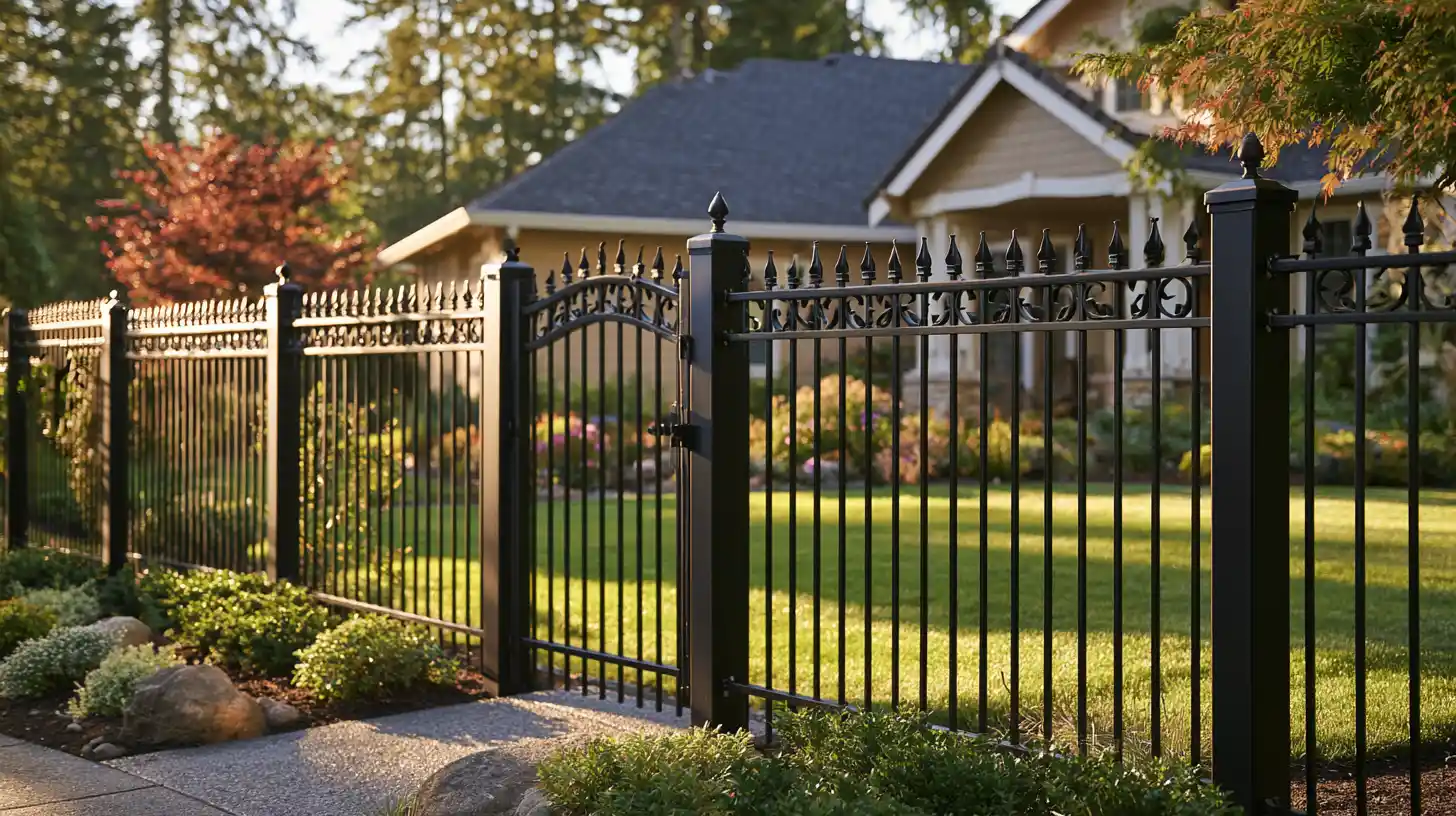
When someone asks for a “wrought iron fence” today, they almost never mean true, slag-bearing, hand-forged iron. They mean the look: black, vertical pickets, a classic ironwork profile, solid and secure. What they get is Ornamental Iron or ornamental steel, and sometimes aluminum, built to achieve that traditional appearance. This is the single most important thing to understand before you buy. “Wrought iron” is usually a style name. Ornamental steel is a material specification, and the visual appeal drives the demand more than any metallurgy does.
The distinction has a real standard behind it. ASTM F2408 covers ornamental fences that use galvanized steel tubular pickets, setting minimum requirements for coated tubular picket systems made from galvanized steel components. It references structural test methods along with coating tests for adhesion, corrosion resistance, impact resistance, and weathering resistance. That’s the modern quality framework for the kind of fence most people call wrought iron. Coatings sometimes have to resist aluminum oxides and other weathering products depending on the base metal, but the coating system is what keeps the fence highly resistant to rust over time.
Note what F2408 explicitly excludes. It does not apply to vertical bar fence systems using solid bar or wrought iron materials. So “ornamental steel fence” and “true wrought iron fence” are not the same specification category, even when they look nearly identical from the sidewalk. One is a coated, standardized, often machine-welded steel system. The other is a historic, hand-worked material you’d only specify for restoration. Unlike wrought iron, which had to be forged by hand one piece at a time, ornamental steel is drawn, cut, and welded to repeatable tolerances, so panels match and installation stays predictable. Modern steel also has a lower melting point to manage in fabrication than some historic processes required, which keeps production consistent.
Modern ornamental steel earns its place. It’s produced to consistent tolerances, welded on jigs for repeatable quality, and coated to fight corrosion. That standardization is a strength for anyone who needs a fence that installs cleanly and performs predictably. It also opens the door to custom designs that would have been slow and costly in true wrought iron, since a fabricator can weld pickets, rails, and decorative elements into whatever profile a site calls for. Where old work relied on other forms of hand shaping, today’s shop uses jigs and welders. At Inline Security Fence, we install Ornamental Iron for both commercial and residential clients, and we’re direct about what the system actually is, so the fence you picture matches the one that goes in the ground. Steel that is painted black over a proper coating is what most people mean when they picture a “wrought iron” fence.
What This Means for Commercial Properties
For a facility manager or commercial property owner, the metal’s name matters less than what the fence has to do. The real conversation is about performance: perimeter security, durability, access control, sightlines, documentation, and long-term maintenance. Ornamental steel handles all of these well when it’s specified and coated correctly, and its visual appeal is a bonus, not the driving reason.
When security is the priority, there’s a standard built for exactly that. ASTM F2814 is a guide for design and construction of ornamental steel picket fence systems for security purposes. It covers the material and installation choices that turn a good-looking fence into a serious perimeter. The guide describes several ways to harden an ornamental steel picket system:
- Increasing fence height
- Using outward-curving, parapet-style pickets to resist climbing
- Decreasing spacing between vertical pickets
- Adding security accessories
- Using supplemental fill materials
- Creating isolation zones with multiple fence lines
- Adding anti-ram cable systems
Which of these you actually need depends on the site and the threat you’re planning around. A healthcare campus, a petroleum facility, and a distribution yard have different requirements, and a good estimator will talk through them before quoting rather than after. Picket spacing that keeps a hand from reaching through, a height that discourages climbing, and a coating that survives coastal weather are all separate decisions that add up to one perimeter. Properly coated and maintained ornamental steel gives strong corrosion resistance and long service, which is why it’s a practical choice for perimeters that have to look right and hold up for years.
This is core work for us. Inline Security Fence has dedicated commercial estimators, and we handle High Security fencing and custom fabrication for commercial clients across the greater Seattle-Tacoma area. When the perimeter matters, the material choice is one line in a much larger spec, and we’d rather get that whole spec right with you than hand you a fence and hope.
What This Means for Gates and Automation
If your fence includes a gate, and especially if that gate is automated, the material name tells you almost nothing about whether it will work safely. Gate construction, hardware, operator compatibility, and entrapment protection all matter more than whether the pickets are called wrought iron or ornamental steel. A gate is a moving assembly, and moving assemblies have their own standards. A heavy gate frame welded from carbon steel tubing behaves very differently from a lighter aluminum one, and the operator has to be matched to that weight.
ASTM F2200 covers the construction of automated vehicular gates and requires compliance with UL 325 for the operator side. It addresses six gate types: horizontal slide, horizontal swing, vertical lift, vertical pivot, overhead pivot, and horizontal bifold. It also sorts installations into four use classes, which is a useful way to think about your own site:
- Class I: residential, for one to four single-family dwellings
- Class II: commercial or public access, including multifamily of five units or more
- Class III: industrial use
- Class IV: guarded, restricted-access industrial
For manual gates, ASTM F900 covers industrial and commercial swing gates, defining performance methods and minimum requirements for that application. The right standard depends on whether the gate swings or slides, whether it’s powered, and how the site is used.
One caution on scope: automated gate requirements can be shaped by local code adoption, project type, and manufacturer instructions on top of the ASTM and UL standards. Verify what your jurisdiction actually enforces rather than assuming one rule applies everywhere. We handle gate installation including automation and custom fabrication, so we can match the gate type, operator, and safety hardware to how your property actually operates, then document it clearly.
How to Talk to a Fence Contractor About “Wrought Iron”
If you’ve been burned before by a vague quote, this is the section to keep. Ask these questions up front and the whole project gets clearer, because the answers force the material, the finish, and the workmanship into the open where you can see them. Modern fences marketed as wrought iron are usually mild steel, so the first question is the one that resolves most confusion:
- Is this true wrought iron, ornamental steel, aluminum, or custom-fabricated steel? Get the actual material named, not just the style. If someone says “wrought iron,” ask whether they mean the historic metal or the look built from carbon steel.
- How is it finished? Galvanized, powder-coated, painted, or some combination. Coating is what fights corrosion, so this determines how the fence ages.
- What are the post, rail, and picket specifications? Sizes and gauges affect strength and how the fence holds up long term.
- Are the gates manual or automated? This changes the hardware, the standards, and the cost of getting it right.
- Which safety standards apply to the automation? Expect ASTM F2200 and UL 325 to come up for automated vehicular gates.
- Can the design be customized? Ornamental steel supports custom designs, so ask whether the profile, height, and accents can match your site rather than a stock catalog.
- What warranty or guarantee covers the work and the materials? Get it in plain terms.
- What maintenance should I expect? Even well-coated steel needs upkeep to keep resisting rust, and it holds up best when it is properly maintained.
A contractor who answers these plainly is a contractor you can plan around. We offer guarantees on our work and materials, and we keep communication clear from the estimate through the final walk, with a named point of contact rather than a phone tree. If a quote comes back thin on material detail, ask for it in writing before you sign. A fence is a long-term purchase, and the difference between a well-specified ornamental steel system and a vague “wrought iron” line item is the difference between a fence that performs for decades and one that surprises you in year three.
The Bottom Line on Rod Iron vs. Wrought Iron
“Rod iron” is a misspelling of “wrought iron,” and wrought iron itself is a historic material that stopped being produced commercially in the 1970s. What you’ll actually buy today is ornamental steel, engineered to consistent tolerances, coated to fight corrosion, and built to standards like ASTM F2408 that true wrought iron never had. That isn’t a downgrade. It’s a different product with real advantages, and knowing which one you’re specifying is what keeps your expectations and your quote in the same place.
Whether you’re securing a commercial perimeter, automating a gate, or just want that classic black picket look around your property, the questions above will get you a straight answer. Inline Security Fence serves commercial and residential clients across the greater Seattle-Tacoma area with Ornamental Iron, High Security fencing, gate automation, and custom fabrication. Reach out and we’ll walk your site with you.
Frequently Asked Questions
Is “rod iron” a real thing, or just a misspelling of “wrought iron”?
It’s almost always a misspelling or mishearing of “wrought iron.” There is a narrow technical sense in which “rod iron” describes iron rolled or drawn into thin round bars, which you might hear in a metalworking shop, but that usage rarely comes up in fencing. Washington State University’s Common Errors in English Usage makes the same point: people who write “rod iron” mean “wrought iron.” “Wrought” is the old past participle of “work,” so wrought iron literally means worked iron.
Are wrought iron fences still made today?
Not from true wrought iron. Genuine production ended in the United States in 1969, Britain’s last wrought ironworks closed in 1974, and Historic England notes there has been no industrial production of historic wrought iron since the 1970s. Real wrought iron now exists mainly as a salvaged restoration material. Nearly every new fence sold as “wrought iron” is ornamental steel built to mimic the traditional look, typically galvanized steel tubular pickets covered by ASTM F2408, which explicitly excludes solid bar and true wrought iron systems.
What’s the difference between wrought iron and cast iron?
Carbon content and how they’re made. Wrought iron is low carbon, under 0.3% and usually under 0.1%, with roughly 1 to 2% slag mixed through it, giving it a fibrous grain that lets it bend without breaking. Cast iron is the high-carbon one, typically above 2%, melted and poured into molds, which makes it hard but brittle and prone to cracking under impact. A common error worth correcting is describing wrought iron as high carbon; it’s the opposite. Melting wrought iron down and casting it destroys the fibrous structure that defines it.
How do I know what material a contractor is actually quoting me?
Ask directly whether it’s true wrought iron, ornamental steel, aluminum, or custom-fabricated steel, and don’t accept “wrought iron” as the answer since that names a style, not a material. Then ask how it’s finished, since galvanizing, powder coating, and paint determine how the fence handles corrosion, and get post, rail, and picket sizes and gauges in writing. If gates are involved, ask whether they’re manual or automated and which standards apply, since ASTM F2200 and UL 325 govern automated vehicular gates.